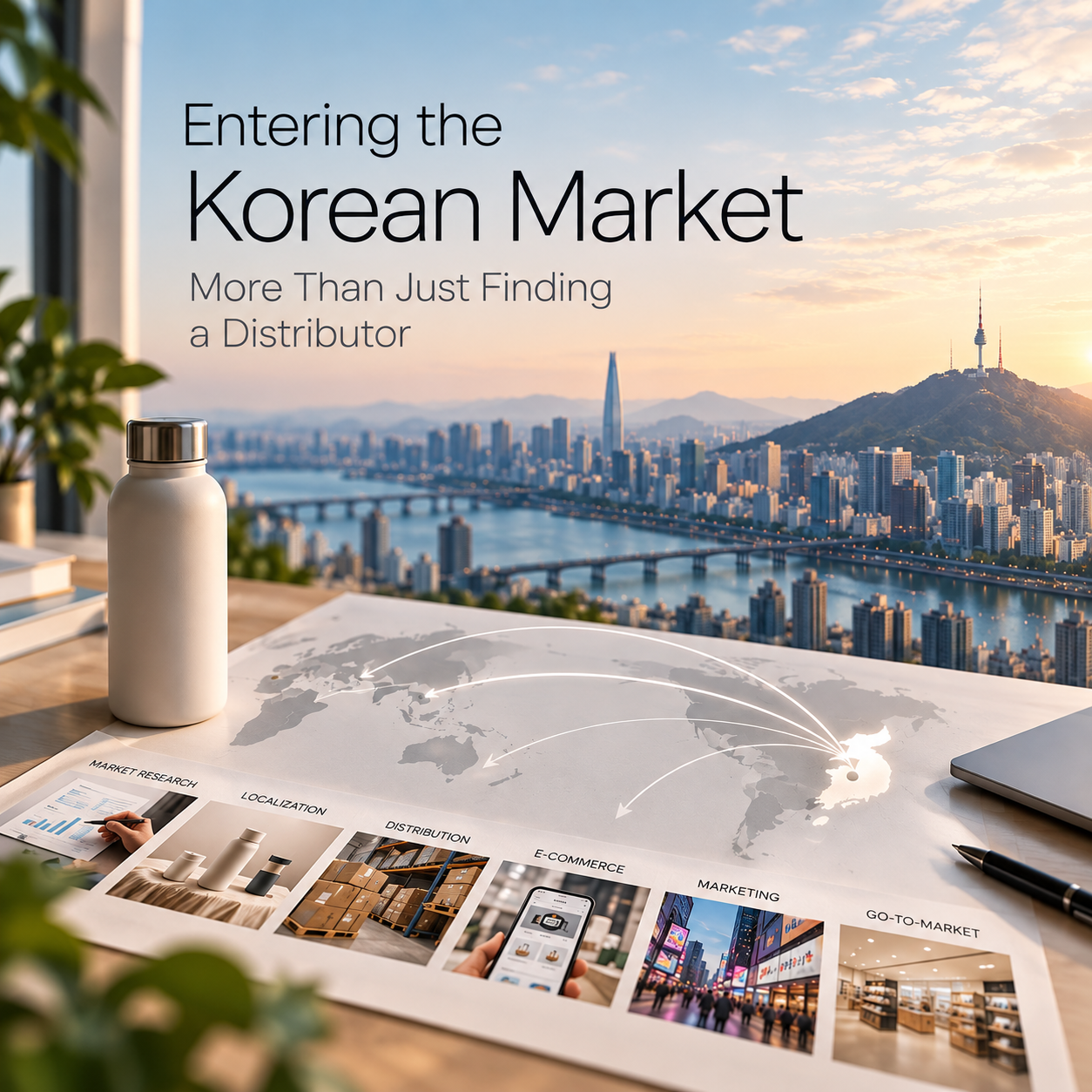

South Korea offers global brands access to a highly connected consumer market, sophisticated logistics and an established e-commerce ecosystem. Yet a successful Korean market entry takes more than translating a website or appointing a distributor. The route to market, import responsibilities, local product positioning and day-to-day execution must fit together.
This practical guide explains how overseas consumer brands can assess demand, choose a market-entry model and build a realistic launch plan in South Korea.
1. Validate demand before choosing a sales partner
Begin with the customer, not the channel. Research the local category, relevant competing products, retail prices, packaging expectations, review patterns and typical purchase triggers. A product with strong international sales is not automatically differentiated in Korea.
Useful questions include: What problem does the product solve for Korean buyers? Which domestic and imported brands already solve it? What proof points support a premium price? Can packaging, product claims and customer support be localized without changing the brand’s positioning?
Use Korean-language search results, marketplace listings, customer reviews and direct buyer interviews to test your assumptions. Develop a focused target segment and a product-level value proposition before committing to a large inventory order.
2. Select the right Korean market-entry model
There is no single entry structure that fits every brand. Consider who will own inventory, who will act as importer, who is legally responsible for the product, who sets retail prices and who operates the customer relationship.
Distributor or importer-led model
A local distributor may purchase and import inventory, manage sales channels and handle fulfillment. This can simplify execution, but the contract should clearly define exclusivity, channel rights, pricing responsibilities, marketing commitments, reporting and exit terms. A distributor relationship does not automatically create consumer demand.
Local operating or sales agency
An agency can help coordinate market research, channel setup, campaigns and marketplace operations while the brand retains a greater role in strategy and economics. However, an operating agency is not automatically a licensed importer or merchant of record. Importer, seller, tax and consumer-service responsibilities need separate confirmation.
Direct-to-consumer and cross-border sales
Cross-border or direct-to-consumer sales may help a brand test demand with less local infrastructure in some categories. However, eligibility, customs handling, payment experience, customer returns and product-specific rules can limit the model. A standalone Korean website also needs a credible plan to attract traffic.
For a more detailed comparison, read Do You Need a Distributor to Enter Korea?
3. Check import, labeling and product compliance early
Product compliance is not a final administrative task. Requirements differ across food, supplements, cosmetics, electrical products, children’s products and other regulated categories. Relevant issues may include importer qualifications, product registration or certification, Korean labeling, advertising claims and import documentation.
According to the U.S. International Trade Administration’s South Korea import requirements guide, customs processes involve documentation such as commercial invoices, packing lists and import declarations; some regulated goods require additional approvals.
Before approving packaging or dispatching commercial inventory, ask a qualified Korean customs broker and the appropriate regulatory specialist to review the exact product, ingredients or materials, intended claims and import structure. General market-entry advice cannot replace a category-specific compliance determination.
4. Understand how Korean consumers discover and purchase products
South Korea’s e-commerce environment is not organized around a single search engine or marketplace. Naver, Coupang, brand-operated stores and social channels play different roles in discovery, comparison, conversion and repeat purchasing.
Naver: search, product comparison and content discovery
Naver Shopping and Naver’s broader search ecosystem can connect product listings with brand content, reviews and search-led discovery. Korean-language product information and credibility signals matter. A strong product page alone is unlikely to replace the need for search visibility.
Coupang: purchase intent, convenience and operational reliability
Coupang is an important marketplace for many consumer categories. Brands considering the platform should examine fulfillment requirements, fees, competitive pricing, returns, reviews and contribution margins instead of judging opportunity by sales volume alone.
D2C: brand control and first-party relationships
A Korean direct-to-consumer store can support brand storytelling, repeat-purchase initiatives and customer relationship management. But local checkout convenience, Korean customer service, mobile usability and traffic acquisition still need investment.
The International Trade Administration’s South Korea e-commerce overview also identifies major marketplaces and the importance of mobile commerce. For practical channel selection, see Naver vs Coupang vs D2C: Where Should Global Brands Sell in Korea?
5. Build your Korean pricing model from landed cost
A viable retail price has to support the complete operating chain. Start with product cost, freight, duties where applicable, import taxes and clearance-related expenses. Then model domestic warehousing, fulfillment, platform fees, payment charges, returns, promotions and marketing costs. Treat recoverable taxes correctly in consultation with an accountant rather than automatically treating every tax payment as a permanent expense.
Compare the resulting target price with Korean customer expectations and competing products. If the required selling price is significantly above the category norm, the brand needs strong differentiation or a different operating model.
See our detailed planning article: Korea Market Entry Cost: What Global Brands Should Budget For.
6. Localize the customer journey—not only the words
Effective localization covers product naming, benefit hierarchy, visual assets, mobile product pages, frequently asked questions, Korean-language customer support and return policies. Packaging must also be reviewed against applicable rules rather than translated mechanically.
Marketing messages should be supported by evidence and comply with local advertising rules. Claims that are acceptable in another market may not be suitable for use in Korean advertising, particularly for health, beauty and other sensitive categories.
7. Design a measurable launch strategy
Rather than distributing the budget evenly across every channel, prioritize a small set of hypotheses. Define what will count as evidence of product-market fit and agree on decision points before spending.
Phase A: Market readiness
Map competitors, validate your positioning, establish compliance responsibilities, confirm unit economics, and decide on channel ownership. Prepare Korean product assets and customer service procedures.
Phase B: Controlled market test
Launch a limited assortment in one or two appropriate channels. Test search demand, product-page messaging, creative concepts and the operational process for fulfillment, complaints and returns. Use small, controlled campaigns before expanding inventory exposure.
Phase C: Optimize and scale
Review contribution margin, customer acquisition cost, conversion rate, repeat purchase, returns and channel-specific profitability. Expand only where results justify the next level of investment.
These phases are a planning framework, not a fixed timeline. Launch duration depends on category-specific compliance, supply lead times, approvals and the chosen commercial structure.
8. Avoid common Korea launch mistakes
- Appointing a distributor before validating the brand proposition: access to channels does not guarantee sell-through.
- Copying global pricing: landed cost and local competitor prices may materially change the economics.
- Launching without a Korean-language customer journey: customers need clear product information and dependable support.
- Underfunding post-launch marketing: opening a storefront does not create demand by itself.
- Ignoring channel conflicts: marketplace pricing and distribution agreements can affect long-term brand positioning.
- Scaling before measuring profitability: revenue without channel-level margins can conceal an unsustainable operation.
Read 7 Common Mistakes Global Brands Make When Entering the Korean Market for an expanded checklist.
9. Your Korea market-entry checklist
- Define the target audience and core customer problem.
- Benchmark Korean category prices and competing products.
- Confirm importer, seller, inventory and after-sales responsibilities.
- Review product-specific certification, labeling and advertising requirements.
- Build a landed-cost and channel-margin model.
- Choose the initial marketplace, distribution or D2C structure.
- Prepare localized product pages, brand assets and support processes.
- Set a launch budget, measurement plan and go/no-go criteria.
For more questions to ask before launching, explore 아무도 알려주지 않는 한국 시장 진출 체크리스트.
10. Work with a Korea market-entry partner
Entering South Korea is a series of connected commercial decisions, not a single distribution agreement. Overseas brands need a coherent approach to positioning, channel strategy, e-commerce execution and ongoing performance measurement.
BRAUM PARTNERS works at the intersection of brand strategy and Korean e-commerce market entry. If your team is evaluating a Korea launch, we can discuss your brand’s category, proposed sales structure and the commercial work required to move forward.
Discuss your Korea market-entry plan with BRAUM PARTNERS →
Editorial note: Regulatory and tax requirements depend on the product and transaction structure. Verify current requirements with qualified Korean specialists before making binding decisions.