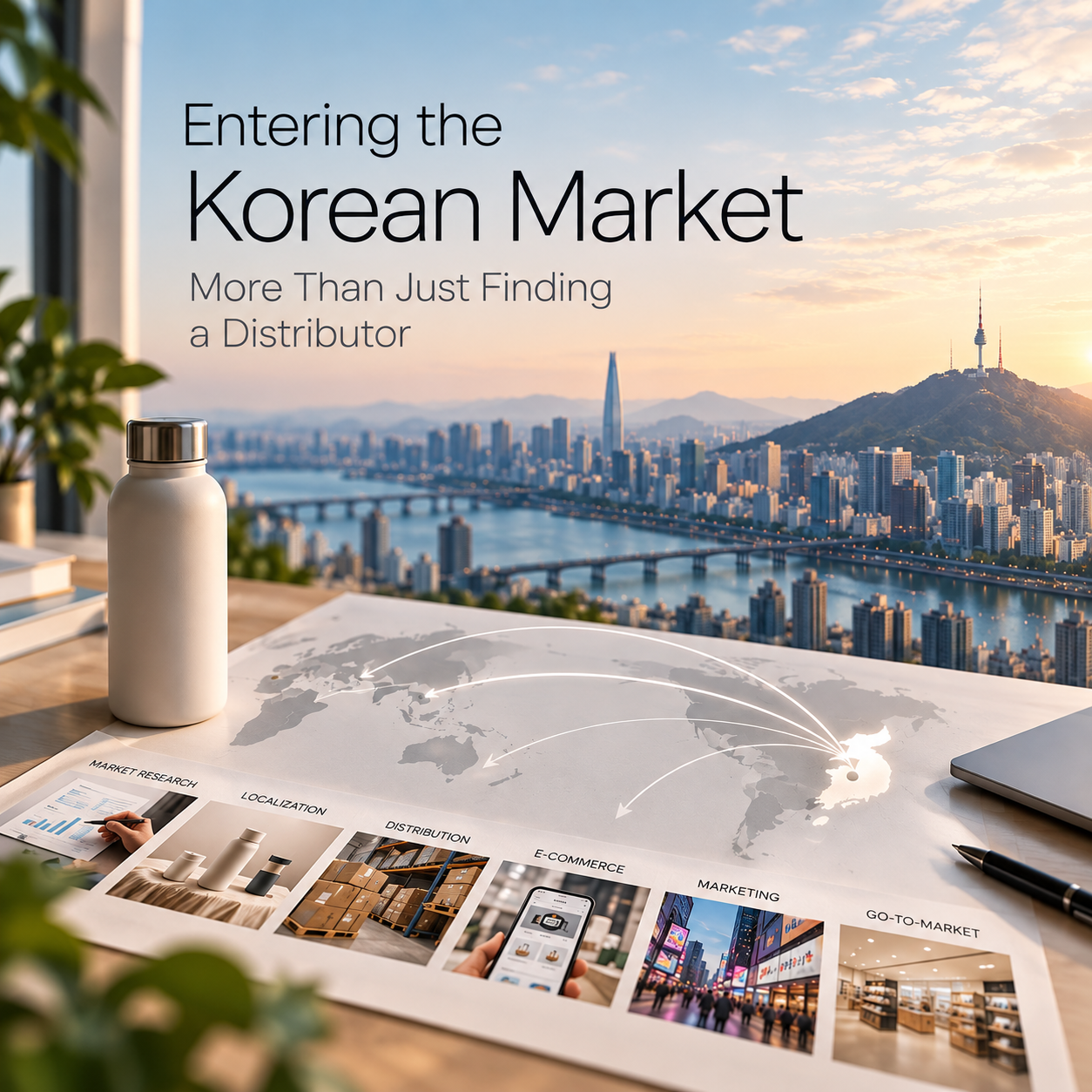
For global consumer brands, entering the Korean market can look deceptively simple.
Find a local distributor.
Set a wholesale price.
Translate the product information.
Start selling.
But Korea market entry is rarely that simple.
A product that performs well in Europe or the United States does not automatically succeed in Korea. The product may be the same, but the market around it is completely different.
Consumers discover brands differently.
Pricing expectations are different.
E-commerce plays a different role.
Distribution structures are different.
And the way consumers evaluate a new brand can be very different as well.
This is why entering Korea should not be treated simply as an export decision.
It requires a Korean market entry strategy.
1. Start with the market, not the distributor
One of the first questions international brands often ask is:
“Who can distribute our products in Korea?”
It is an important question, but it should not always be the first one.
Before choosing a distributor, a brand needs to understand where it could realistically compete.
Who is the customer?
Which brands are already competing for that customer?
What price range does the market accept?
Where are comparable products being sold?
And most importantly:
Why would a Korean consumer choose this brand instead?
Without clear answers, finding a distributor may simply mean putting products into a market without a clear position.
Distribution should follow strategy, not replace it.
2. Global pricing does not automatically translate to Korea
Pricing is another area where international brands can underestimate the complexity of entering Korea.
The original retail price is only the beginning.
Import costs, logistics, duties, VAT, distributor margins, retailer margins, marketplace commissions, promotional costs, and marketing expenses can all affect the final consumer price.
This means a product that is competitively priced in its home market may suddenly enter a very different competitive position in Korea.
The question is therefore not simply:
“How much should we sell it for?”
A better question is:
“At what price can this brand compete, maintain its positioning, and still operate sustainably in Korea?”
That is a commercial strategy question, not just a pricing calculation.
3. Localization is not translation
One of the most important parts of brand localization in Korea is understanding the difference between translation and localization.
Translation changes the language.
Localization changes the context.
A message that works in Europe may not create the same response in Korea.
Product benefits may need a different hierarchy.
Visual communication may need adjustment.
The competitive frame may be different.
Even the reason customers buy the category may be different.
But localization does not mean changing everything.
Over-localization can remove exactly what made an international brand interesting in the first place.
The real challenge is deciding:
What should remain global, and what should become local?
Strong localization protects the original identity of the brand while making that identity relevant to Korean consumers.
4. Korea is not a single-channel market
A Korea distribution strategy also needs to consider how connected the market has become.
D2C, marketplaces, retail, B2B distribution, social commerce, influencers, search, and offline experiences can all influence the same purchase decision.
For many consumer brands, simply appointing one distributor and waiting for sales is not enough.
The brand needs to think about the role of each channel.
What should D2C do?
Which marketplaces make sense?
Does offline retail strengthen the brand or simply increase availability?
Should the brand enter B2B first, D2C first, or operate both?
And how should pricing remain consistent across those channels?
Channel decisions eventually become brand decisions.
Where a product is sold influences how the product is perceived.
5. Korean e-commerce requires its own strategy
Korea has a highly developed digital commerce environment.
Consumers can discover a product, compare prices, read reviews, search for alternatives, and purchase within a very short period of time.
That means Korean e-commerce strategy cannot be treated merely as opening an online store.
Product pages need to communicate value quickly.
Reviews create trust.
Search visibility matters.
Content influences discovery.
Pricing can be compared instantly across multiple channels.
The entire digital customer journey needs to be considered as part of the market-entry strategy.
6. Marketing should begin before launch
Marketing is often treated as the final stage of market entry.
First import the product.
Then establish distribution.
Then start marketing.
I believe the sequence should be different.
Marketing questions should be considered much earlier.
Who are we trying to reach?
What problem does the product solve for them?
What will make them notice it?
What will make them trust it?
What will make them choose it over an existing alternative?
If those questions are asked only after the product arrives in Korea, many important decisions have already been made.
A strong go-to-market strategy for Korea connects product, positioning, pricing, distribution, commerce, and marketing before launch.
Korea market entry is ultimately brand building
Entering Korea is not simply about making a product available in another country.
It is about creating a reason for that product to exist in the Korean market.
That requires understanding the market, finding the right position, building the right commercial structure, and communicating the brand in a way that local consumers can understand.
The original brand should not disappear in that process.
It should become more relevant.
That is why I see Korea market entry as a form of brand building.
Understand the brand.
Understand the Korean market.
Decide what should remain unchanged.
Decide what needs to adapt.
Then connect everything into one coherent market strategy.
A successful market entry does not simply bring a global brand to Korea.
It gives the brand a reason to be chosen in Korea.